1. Introduction: The Great American Paradox
The global political landscape is currently undergoing a seismic shift. For nearly a century, the United States has been the undisputed architect of the world order. However, the debate surrounding Trump US Power Decline has moved from academic circles to the center of global geopolitics. As the “America First” agenda takes hold, many wonder if the U.S. is overstretching its reach exactly when its foundations are most fragile.
Is Donald Trump’s aggressive stance a masterstroke of survival, or is it the catalyst that accelerates the end of the “American Century”? To answer this, we must look beyond the headlines and analyze the structural, economic, and social forces at play.
2. The Theory of Imperial Overstretch
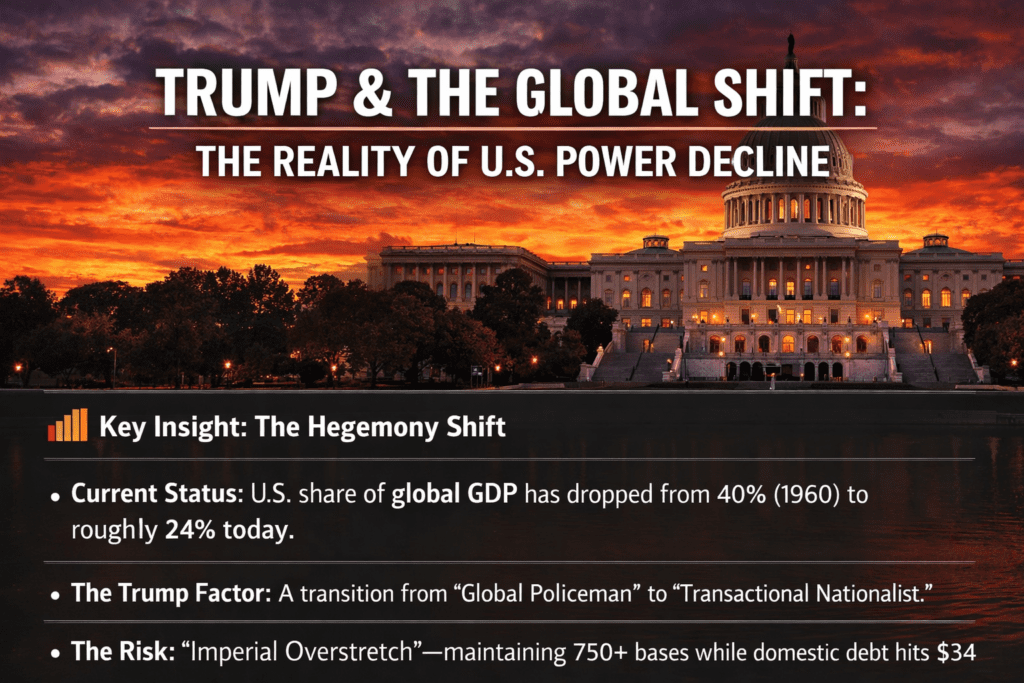
To understand the Trump US Power Decline, we must first look at history. In his seminal work, The Rise and Fall of the Great Powers, historian Paul Kennedy introduced the concept of “Imperial Overstretch.” This occurs when a nation’s global commitments—military bases, foreign aid, and security guarantees—exceed its economic capacity to sustain them.
Currently, the U.S. maintains over 750 military bases in 80 countries. While Trump argues that allies are “free-riding” on American protection, his solution—threatening to withdraw while simultaneously demanding total loyalty—creates a “Power Vacuum.” History teaches us that whenever a superpower retreats, a rival is always ready to step in.
3. Internal Factor: The Rot Within the Fortress
No empire falls to foreign invaders before it rots from within. One of the primary drivers of the Trump US Power Decline is the internal state of the American union.
The Poison of Political Polarization
America is more divided today than at any point since the Civil War. Political polarization has turned neighbors into enemies and stalled the legislative process in Washington. When a nation cannot agree on its own history or the validity of its elections, it loses the “Moral Authority” required to lead the world.
Crumbling Infrastructure
While China builds 40,000 kilometers of high-speed rail, American infrastructure is failing. Bridges, power grids, and water systems are aging. Trump’s “America First” promised a domestic renewal, but the reality is that the U.S. is struggling to maintain its own house while trying to dominate the global stage.
4. The Economic Reckoning: Debt and De-Dollarization
The most dangerous threat to American hegemony is not a military one, but a financial one. The economic aspect of the Trump US Power Decline is tied directly to the U.S. Dollar.
The $34 Trillion Shadow
The U.S. national debt is a ticking time bomb. Both political parties have contributed to a deficit that now exceeds 120% of the nation’s GDP. Trump’s 2017 tax cuts, while stimulating growth, added trillions to this debt. When interest payments on the debt start to cost more than the national defense budget, the empire is in financial peril.
The Rise of BRICS and the End of the Petrodollar
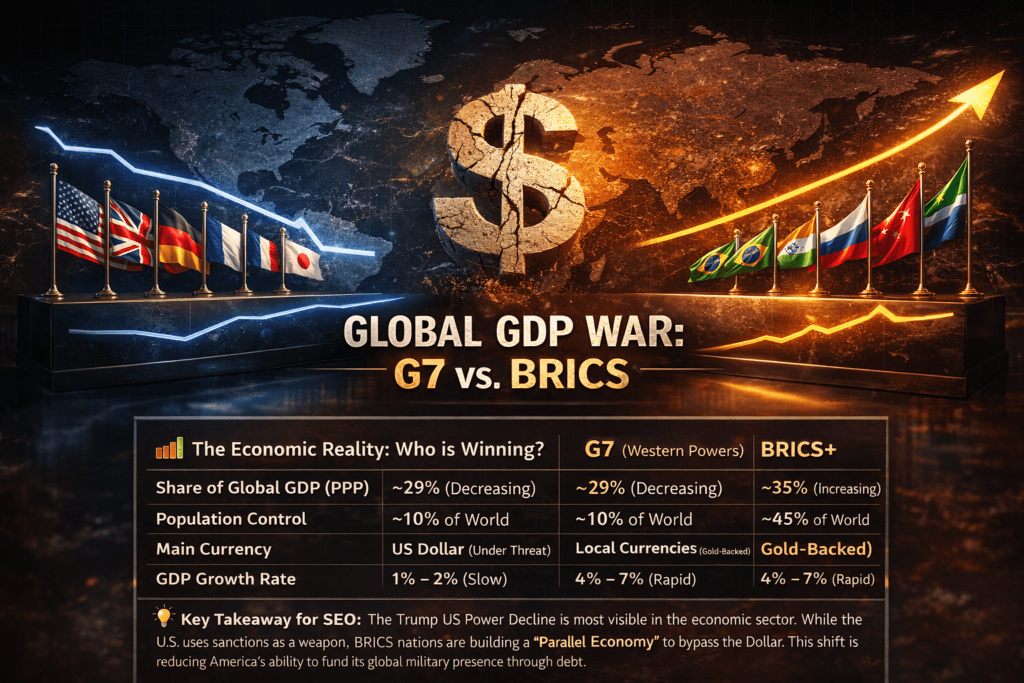
For decades, the world traded oil in dollars. This “Petrodollar” system allowed the U.S. to print money without consequence. However, we are now seeing a global “De-dollarization” movement. Nations like China, Russia, and India are trading in local currencies. If the dollar loses its status as the world’s reserve currency, the Trump US Power Decline will become an undeniable reality overnight.
5. External Factor: The Rise of a Multipolar World
The era of the “Unipolar” world—where the U.S. was the only superpower—is over. We are now in a multipolar world where power is distributed among several giants.
The Dragon’s Ascent: China
China is no longer just a manufacturing hub; it is a technological and military superpower. Through the Belt and Road Initiative , Beijing has created an alternative economic ecosystem. Trump’s trade wars were intended to “stop” China, but they instead accelerated China’s drive for self-reliance in semiconductors and Artificial Intelligence.
The Search for Strategic Autonomy in Europe
Trump’s skepticism toward NATO has forced traditional allies like France and Germany to seek “Strategic Autonomy.” If Europe builds its own defense force and reduces its reliance on Washington, the U.S. loses its most significant lever of power in the West.
6. The Silicon War: AI and the New Arms Race
Power in the 21st century is defined by who owns the “Brains” of the world. The battle for microchips and AI is the new “Nuclear Race.”
The U.S. currently leads in AI design, but it relies on Taiwan (TSMC) for manufacturing. A key part of the Trump US Power Decline narrative is the vulnerability of the global supply chain. If the U.S. cannot secure its technological future while simultaneously alienating its trade partners, it will lose the “Fourth Industrial Revolution” to Beijing.
7. The Erosion of Soft Power: Brand America in Crisis
“Soft Power” is the ability to attract others through culture and values rather than force. Historically, the world wanted to follow the “American Dream.”
Under the “America First” banner, that dream has become a “Fortress.”
-
Isolationism: Withdrawing from the Paris Climate Agreement and the Iran Nuclear Deal signaled that the U.S. is no longer a reliable partner.
-
Trust: When a superpower behaves unpredictably, its words lose value.
Without Soft Power, the U.S. must rely on “Hard Power” (sanctions and military). Hard power is expensive, breeds resentment, and is a hallmark of a declining empire.
8. Historical Cycles: The Ray Dalio Perspective
In his book Principles for Dealing with the Changing World Order, billionaire investor Ray Dalio argues that all empires follow a predictable cycle.
-
New Order: Wealth and power grow.
-
The Top: Excessive spending and debt.
-
The Decline: Internal conflict and external wars.
Many believe the U.S. is currently in the “Decline” phase. Trump is not the cause of this cycle, but he is a product of it. His attempt to “Make America Great Again” is a response to the feeling that the country is slipping away. However, by stretching resources and fighting on multiple fronts (Trade wars with China, pressure on NATO, sanctions on Russia), he may be accelerating the timeline of the Trump US Power Decline.
9. How This Affects the Global South
Check out our previous post on Trump Deal: A $300 Billion Blueprint for Global
As the U.S. focuses inward, nations in the Global South are looking for new leaders. From Africa to Southeast Asia, countries are no longer choosing sides between Washington and Beijing. They are practicing “Neutrality,” which further dilutes American influence.
10. Frequently Asked Questions (FAQs)
Q1. What exactly is the ‘Trump US Power Decline’ theory?
Ans: The theory suggests that Donald Trump’s “America First” policies, while focusing on domestic growth, are leading to a retreat from global leadership. This transition from a “Global Policeman” to a transactional power is seen by experts as a sign of the United States’ diminishing influence over world affairs.
Q2. Is the United States really a declining superpower?
Ans: While the U.S. remains the world’s largest military and tech power, its relative share of the global economy has dropped. The rise of China, the expansion of BRICS, and internal political polarization are key factors contributing to what many call the Trump US Power Decline.
Q3. How does the national debt affect American power?
Ans: With a national debt exceeding $34 trillion, the U.S. is spending more on interest payments than on some core services. This financial burden limits the government’s ability to fund global military operations and large-scale infrastructure projects, weakening its international standing.
Q4. What is ‘De-dollarization’ and why does it matter?
Ans: De-dollarization is the process where nations reduce their reliance on the U.S. Dollar for international trade. As countries like China, Russia, and India move to local currencies, the U.S. loses its “exorbitant privilege” of printing money to fund its deficits, accelerating the Trump US Power Decline.
Q5. Can the decline of US power be reversed?
Ans: Yes, but it requires significant structural changes. Experts suggest that to reverse the decline, the U.S. must heal its internal political divisions, invest heavily in 21st-century infrastructure (AI, Green Energy), and rebuild trust with its global allies.
Q6. Does ‘America First’ mean isolationism?
Ans: Not necessarily. “America First” is more about transactional diplomacy—engaging with the world only when it provides a direct, measurable benefit to the U.S. However, this shift often leaves a power vacuum that rivals like China and Russia are quick to fill.
11. Conclusion: Can the Decline Be Reversed?
Is the Trump US Power Decline inevitable? Not necessarily. The United States still possesses the world’s most powerful military, the most innovative tech companies, and a resilient economy.
However, the “stretching” of U.S. power must stop. A nation cannot lead the world if it is at war with itself. To remain a superpower, the U.S. needs to:
-
Fix its national debt.
-
Rebuild its internal infrastructure.
-
Restore trust with its traditional allies.
-
Accept that the world is now multipolar.
Trump’s legacy will be determined by whether his “America First” policy was a successful pivot to save the nation or the final push that sent the empire over the edge.