Introduction: The “New Normal” of Energy Markets
In the fast-moving world of energy commodities, the Global Oil Price Trends 2026 have become a symbol of extreme volatility. We see prices go up, down, and up again within a single trading week. However, one stark reality remains: despite these fluctuations, oil prices are still significantly higher than they were before the onset of major global conflicts.
For investors, policymakers, and High-Net-Worth (HNW) families, understanding Global Oil Price Trends 2026 is essential for navigating inflation, transport costs, and portfolio management. Why hasn’t the price returned to the “stable” 50−60 range we saw years ago? This guide explores the structural shifts keeping oil expensive in 2026.
The Historical Context: Pre-War vs. 2026 Reality

To understand Global Oil Price Trends 2026, we must look back at the baseline. Before the 2022 geopolitical escalations, oil markets operated on a “just-in-time” supply chain. Today, the world operates on a “just-in-case” model.
-
Pre-War Baseline: Average Brent crude was
60–70 per barrel. -
The 2026 Floor: Even during “down” cycles, prices rarely dip below
80–85.
This “new floor” is a direct result of the permanent disruption of supply routes and the heavy sanctions that reshaped global energy trade.
I. The “Up-Down-Up” Cycle: What Drives Volatility in 2026?
1. Geopolitical Risk Premium
The primary driver of Global Oil Price Trends 2026 is the geopolitical risk premium. Conflicts in major oil-producing regions (the Middle East and Eastern Europe) have added a permanent “war tax” to every barrel. Every time a new diplomatic tension arises, prices spike instantly.
2. OPEC+ Production Strategy
OPEC+ has become more surgical in its approach. In 2026, the alliance uses AI-driven market analysis to cut or increase production within hours. This keeps the market in a state of constant tension, contributing to the “up-down” movement that characterizes Global Oil Price Trends 2026.
3. Strategic Reserve Exhaustion
Many Western nations used their Strategic Petroleum Reserves (SPR) to stabilize prices in previous years. By 2026, these reserves are at historic lows, meaning governments have less “ammo” to fight price spikes, leading to the rapid “up” swings we see today.
II. Why Prices Remain Much Higher Than Before the War
Despite the occasional dips, the long-term Global Oil Price Trends 2026 show a sustained upward trajectory. Several structural factors prevent oil from becoming “cheap” again.
1. Infrastructure Underinvestment
For years, the global shift toward “Green Energy” led to a massive reduction in fossil fuel investment. However, the energy transition is taking longer than expected. By 2026, we have a “supply gap”—demand is still high, but the infrastructure to pump more oil hasn’t been built.
2. Re-Routing the Global Supply Chain
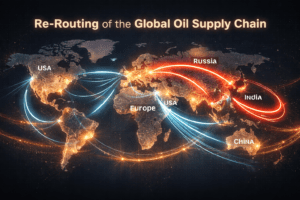
Before the war, Russian oil flowed directly to Europe via pipelines. In 2026, that same oil travels thousands of miles further to reach Asian markets, while Europe imports from the US and Middle East. This increased “ton-mile” distance adds permanent shipping and insurance costs to every barrel.
3. The Inflationary Feedback Loop
Higher oil prices drive up the cost of diesel used in mining and drilling. This makes the cost of producing a barrel of oil higher. In Global Oil Price Trends 2026, we see that even the “breakeven” price for many producers has risen by 20-30%.
III. Regional Breakdown: Continental Impacts of Oil Prices
Understanding Global Oil Price Trends 2026 requires a look at how different regions are coping with the high-price environment.
-
Europe’s Energy Sovereignty: Europe has moved away from Russian pipelines, relying on expensive LNG and US crude. This has made European industry less competitive globally.
-
Asia’s Growing Demand: China and India continue to drive the demand side of Global Oil Price Trends 2026. Their ability to negotiate discounts on sanctioned oil has created a “two-tier” pricing system globally.
-
The Americas: The US has become the world’s “swing producer,” but domestic environmental regulations and high labor costs prevent prices from dropping to pre-war levels.
IV. Impact of Global Oil Price Trends 2026 on HNW Portfolios
High-Net-Worth families and institutional investors are adjusting their HNW Portfolios wealth structures to account for these Global Oil Price Trends 2026.
-
Energy Stocks as an Inflation Hedge: Traditional oil and gas majors are generating record dividends, making them a staple in 2026 portfolios.
-
Direct Commodity Exposure: Investors are using tokenized oil assets to gain liquidity during price spikes.
-
Private Equity in Energy Infrastructure: Massive capital is flowing into specialized refineries that can handle different grades of crude as supply sources shift.
V. The Role of Technology and AI in 2026 Oil Markets
One of the unique aspects of Global Oil Price Trends 2026 is the role of technology.
-
Predictive Analytics: Algorithmic trading now accounts for 80% of daily oil volume, causing the “flash” price movements (the up-down swings).
-
Satellite Monitoring: Traders now use real-time satellite imagery of oil tankers and storage tanks to predict price moves before they hit the news.
VI. The Green Irony: How High Prices Help Renewables
An interesting facet of Global Oil Price Trends 2026 is the acceleration of the green transition. When oil is at $85, the Return on Investment (ROI) for solar, wind, and EV fleets becomes much faster. However, the raw materials for these technologies (lithium, copper) are also transported using oil-based fuels, creating a complex economic tug-of-war.
VII. Strategic Advice for Businesses in 2026
To survive the Global Oil Price Trends 2026, businesses must adopt a “high-energy-cost” mindset:
-
Energy Hedging: Use financial instruments to lock in fuel prices for 12-24 months.
-
Logistical Efficiency: Optimize supply chains to reduce the “miles-per-product” ratio.
-
Alternative Power: Shift manufacturing plants to on-site solar or modular nuclear reactors to bypass the volatile oil-linked power grid.
The Impact of Energy Security on National Sovereignty

In 2026, Global Oil Price Trends 2026 are no longer just an economic metric; they are a matter of national security. Countries that lack domestic energy reserves are forced to form new strategic alliances, often shifting away from traditional Western partners toward the “Global South.” This geopolitical realignment is a direct consequence of the sustained high oil prices that followed the global conflicts of the early 2020s.
Crude Oil Forecast: Will Production Ever Increase?
Looking at the long-term Global Oil Price Trends 2026, the supply side remains constrained. Major oil producers are focusing on “Value over Volume.” Instead of flooding the market to lower prices, they are keeping production tight to maximize profit margins. For the global consumer, this means that the days of $2-per-gallon gasoline are likely gone forever.
How AI is Transforming Oil Price Forecasting
One cannot discuss Global Oil Price Trends 2026 without mentioning the role of Artificial Intelligence. In 2026, hedge funds and energy traders use proprietary AI models to scan news, satellite data, and social media sentiment in real-time. This lead to “Flash Volatility,” where oil prices can jump or drop by $5 in a matter of minutes based on a single AI-driven trade.
Protecting Your Wealth Against Energy Inflation
For the average investor, the Global Oil Price Trends 2026 represent a significant risk to purchasing power. Wealth protection strategies now involve a mandatory 5-10% allocation to energy commodities or infrastructure. By owning the companies that produce the energy, investors can offset the higher costs they pay at the pump and in their utility bills.
VIII. Frequently Asked Questions (FAQ)
Q1: Why won’t oil prices go back to $60 in 2026?
The “breakeven” costs for producers have risen due to inflation, and the geopolitical risk premium is now a permanent feature of the market. $80 is the new $60.
Q2: How do Global Oil Price Trends 2026 affect the Green Energy transition?
Ironically, high oil prices are accelerating the transition by making Electric Vehicles (EVs) and solar power more economically attractive. However, oil remains essential for heavy industry and aviation.
Q3: What happens to oil prices if the wars end?
While a peace agreement would cause a sharp “down” swing, the restructured trade routes (sanctions) and underinvestment in new wells mean prices would likely stay higher than 2021 levels.
IX. Conclusion: Preparing for an Era of High Energy Costs
The Global Oil Price Trends 2026 tell a clear story: the era of cheap, stable energy is over. While we will continue to see the price go “up, down, and up,” the baseline has shifted. Geopolitical instability, supply chain re-routing, and decades of underinvestment have created a market where high prices are a strategic reality.
For businesses and families, the key to surviving Global Oil Price Trends 2026 is flexibility. By understanding the underlying drivers of this “new floor,” you can better hedge your investments and protect your purchasing power in an inflationary world.
3 thoughts on “Strategic Global Oil Price Trends 2026: Why Energy Costs Stay High”