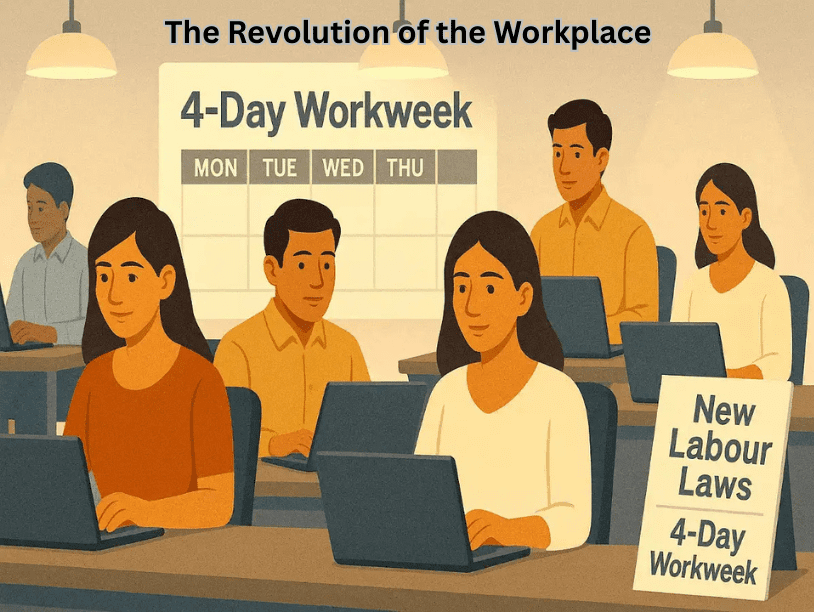
Introduction: The Revolution of the Indian Workplace
Imagine waking up on a Friday morning knowing that your weekend has already begun. For decades, the Indian workforce has been accustomed to the grueling 6-day or 5-day work week. However, as of March 2026, a massive transformation is unfolding. The buzz surrounding the 4 Day Work Week India 2026 has reached a fever pitch, following the latest updates from the Ministry of Labour and Employment.
This isn’t just a trend; it is a fundamental shift in how we perceive productivity and work-life balance. With the implementation of the New Labour Codes, India is joining a global movement that prioritizes mental health without sacrificing economic output. In this exhaustive guide, we will explore everything you need to know about the 4 Day Work Week India 2026, from the legal framework to the impact on your monthly take-home salary.
1. What is the 4 Day Work Week India 2026 Policy?
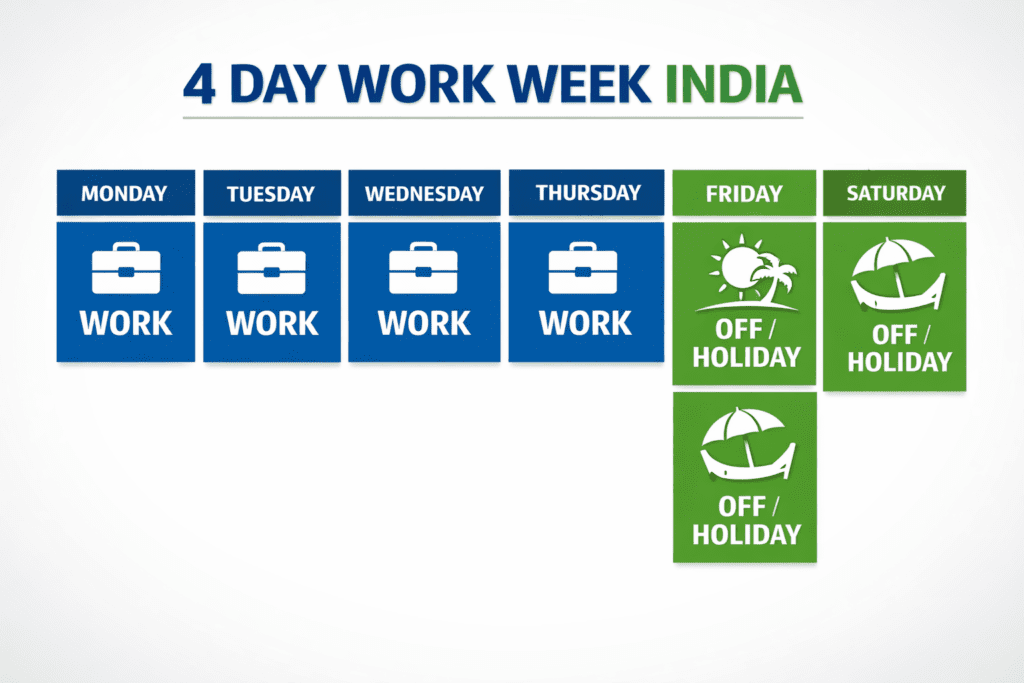
The core of the 4 Day Work Week India 2026 lies in the flexibility offered by the new industrial relations and occupational safety codes. Under these rules, the government allows companies to compress the standard 48-hour work week into four days instead of five or six.
The Mathematical Breakdown:
-
Total Weekly Hours: 48 Hours (As per the Factories Act and New Labour Code).
-
Daily Shift Duration: 12 Hours per day.
-
Weekly Offs: 3 Consecutive days.
While 12 hours might sound intensive, the reward of a 72-hour break every week is proving to be an irresistible draw for the “Gen Z” and “Millennial” workforce.
2. The New Labour Law Rules Explained
The transition to a 4 Day Work Week India 2026 is governed by four major labour codes: The Code on Wages, Social Security, Industrial Relations, and Occupational Safety.
Key Regulatory Pillars:
-
Consent of Employees: Companies cannot force a 12-hour shift without the written consent of the employees or through collective bargaining with unions.
-
Overtime Rules: Any work performed beyond the stipulated 48 hours must be compensated at double the normal wage rate.
-
Rest Intervals: The law mandates a mandatory 30-minute break every five hours to ensure worker safety during long 12-hour shifts.
3. The “Big Question”: Will Your Salary Decrease?
The most searched query regarding the 4 Day Work Week India 2026 is its impact on the paycheck.
Take-Home Salary vs. CTC
Under the new wage code, the “Basic Pay” must constitute at least 50% of the total salary.
-
No Salary Deduction: If you work 48 hours in 4 days, your gross salary remains unchanged.
-
Increased Provident Fund (PF): Since the basic pay component increases, your PF contributions will rise. While this slightly reduces your immediate take-home pay, it significantly boosts your long-term retirement savings and Gratuity.
4. List of Sectors Adopting the 4-Day Model
Not every industry can operate on a 4-day schedule. Based on the 4 Day Work Week India 2026 trends, here is the list of sectors leading the charge:
-
IT and Software Development: Companies like Microsoft and various tech startups are piloting this to attract top talent.
-
Creative Agencies: Graphic design, content marketing, and advertising firms.
-
E-commerce Logistics: Utilizing 12-hour shifts to manage high-volume warehouse operations.
-
Consulting Firms: Moving towards result-oriented work rather than hour-based tracking.

5. The Psychological Impact: Why India Needs This
India currently ranks as one of the most overworked nations globally. The 4 Day Work Week India 2026 is a direct response to the rising rates of corporate burnout and chronic stress.
The Benefits:
-
Reduced Commute: Two fewer days of travel means less time spent in traffic and lower fuel costs.
-
Mental Rejuvenation: A 3-day break allows for “Deep Rest,” leading to higher focus during working days.
-
Environmental Impact: Massive reduction in the carbon footprint of large office buildings.
6. Challenges in Implementing the 4-Day Work Week
Despite the excitement, the 4 Day Work Week India 2026 faces hurdles:
-
Physical Fatigue: A 12-hour workday is taxing for blue-collar workers in manufacturing.
-
Client Coordination: If a client works on a 5-day schedule while the service provider works on a 4-day schedule, it can lead to communication gaps.
-
Childcare and Family Life: Balancing a 12-hour shift with household responsibilities is a major concern for working parents.
7. Global Comparison: India vs. The World
How does the 4 Day Work Week India 2026 compare to other nations?
-
Iceland: The world leader, with over 85% of the workforce on reduced hours.
-
United Kingdom: Conducted the world’s largest trial in 2022-2023 with a 92% success rate.
-
-
Belgium: Officially legalized the 4-day work week in 2022.
India’s model is unique because it maintains the 48-hour requirement, whereas European models often reduce total hours to 32-35 per week.
8. How to Check if Your Company is Eligible?
If you want to know if you can avail of the 4 Day Work Week India 2026 benefits, follow these steps:
-
Review the Employment Contract: Check for clauses related to “Flexible Work Arrangements.”
-
Internal HR Portal: Most companies will list “New Labour Code Compliance” updates in their internal newsrooms.
-
Government Labour Portals: State-specific labour departments are publishing lists of certified “Flexible Work” organizations.

9. Expert Opinions: Is This the Future?
Economic experts suggest that the 4 Day Work Week India 2026 will boost the “Gig Economy” and “Weekend Tourism.” With more free time, Indians are expected to spend more on travel and leisure, fueling the hospitality sector.
10: Case Studies: Companies Already Testing the 4-Day Model
Before the official 4 Day Work Week India 2026 announcement, several forward-thinking startups in Bangalore and Gurgaon began internal trials. Companies like Bbolt and Slic reported a 20% increase in employee retention. By studying these early adopters, the government gathered data on how 12-hour shifts affect long-term fatigue. These case studies prove that when employees are given an extra day of rest, their focus during the working hours is significantly sharper, leading to fewer errors and higher-quality output.
11. Impact on Major Cities: Mumbai, Bangalore, and Delhi
The implementation of the 4 Day Work Week India 2026 will have a profound impact on India’s major urban hubs. In cities like Bangalore (the Silicon Valley of India) and Gurgaon, employees spend an average of 2 to 3 hours daily commuting. By eliminating two commuting days, the 4-day model effectively returns nearly 100 hours of productive or restful time to each employee annually. This shift is also expected to reduce peak-hour traffic congestion by an estimated 20%, leading to a significant drop in urban air pollution levels.
12. The Shift from “Presence” to “Performance”
Historically, Indian work culture has valued “staying late” over “working smart.” The 4 Day Work Week India 2026 is designed to break this stigma. Companies are now adopting high-end productivity tracking tools and Agentic AI to measure output rather than hours logged. This transition ensures that even with fewer days in the office, the economic throughput remains high. It encourages employees to eliminate distractions and focus on deep-work blocks, which is essential for high-value industries like software engineering and legal consulting.
13. Detailed Comparison: The Old 6-Day vs New 4-Day Week
India has long been known for its grueling 6-day work weeks in many sectors. Moving directly to a 4 Day Work Week India 2026 is a massive leap. While a 6-day week offers 8-hour days (48 hours total), it leaves only one day for recovery, leading to high burnout rates. The new 4-day model maintains the 48-hour total but consolidates work into 12-hour shifts. Experts argue that while 12 hours is physically demanding, the psychological benefit of a 3-day recovery period outweighs the fatigue of a long workday.
14. Future Projections: Work Culture in 2027 and Beyond
As we look past the initial rollout of the 4 Day Work Week India 2026, the future looks bright for the Indian labor market. By 2027, it is predicted that over 40% of India’s white-collar workforce will have transitioned to some form of flexible scheduling. This will likely make India one of the most attractive destinations for global “Digital Nomads” and international corporations looking for a healthy yet highly productive workforce.
15. The Impact on Women in the Indian Workforce
One of the most significant advantages of the 4 Day Work Week India 2026 is its potential to increase female labor force participation. In India, many women drop out of the workforce due to the double burden of managing household chores and a full-time job. A 3-day weekend provides the necessary breathing room to manage family responsibilities while remaining committed to a high-intensity career. Experts believe that this flexibility will encourage more women to take up leadership roles, as they can better balance their personal and professional lives without the burnout associated with a 6-day week.
16. Mental Health and the “Burnout Epidemic”
India has been facing a silent “Burnout Epidemic” in its corporate sector. The 4 Day Work Week India 2026 is a direct antidote to this crisis. Long-term psychological studies suggest that a 3-day break allows the brain to fully disconnect from work-related stress, leading to a “reset” effect. When employees return to work on Monday, their levels of cortisol (the stress hormone) are significantly lower, and their creative problem-solving abilities are at their peak. This policy is a move toward a more compassionate and human-centric work culture.
17. Essential Tools for a 12-Hour Workday
As companies transition to the 4 Day Work Week India 2026, employees must adapt to longer shifts. To remain productive during a 12-hour day, certain tools are becoming essential:
-
Time Blocking Apps: Tools like Todoist or Notion help in managing deep-work sessions.
-
Agentic AI Assistants: Using AI to handle repetitive tasks like email filtering and scheduling.
-
Ergonomic Workspaces: With longer hours spent at the desk, investing in high-quality ergonomic chairs is crucial for spinal health.
18. The Economic Ripple Effect: Tourism and Leisure
The 4 Day Work Week India 2026 will not just change how we work; it will change how we spend. With a guaranteed 3-day weekend, the domestic tourism industry in India is expected to see a massive boom. Destinations within driving distance of major hubs like Mumbai, Pune, Delhi, and Bangalore will see a surge in “weekend getaway” bookings. This will create millions of indirect jobs in the hospitality, transport, and local handicraft sectors, effectively boosting the rural economy alongside the urban one.
19. Challenges for the HR Departments
Implementing the 4 Day Work Week India 2026 is a logistical challenge for HR managers. They must now manage complex rosters to ensure that while some employees are off on Friday, the business operations continue seamlessly. This requires a robust digital infrastructure and a shift toward “Asynchronous Communication”—where work progresses even if all team members are not online at the same time.
20. Public Transport and Infrastructure Adjustments
Government bodies are also keeping a close eye on the 4 Day Work Week India 2026 rollout. With millions of workers potentially staying home on Fridays, public transport schedules (like the Mumbai Local or Delhi Metro) may need to be adjusted. A reduction in peak-hour traffic on Fridays will lead to massive savings in fuel consumption for the nation, aligning with India’s “Green Energy” goals for 2030.
21. Final Verdict: A Leap of Faith for New India
In conclusion, the 4 Day Work Week India 2026 is a bold leap of faith. It challenges the traditional notions of hard work and replaces them with the concept of “Smart Work.” As we move through 2026, the success of this model will depend on the mutual trust between employers and employees. If India can prove that it can maintain its 7%+ GDP growth while working fewer days, it will set a golden standard for the rest of the developing world to follow.
22. Frequently Asked Questions (FAQs)
Q1: Is the 4-day work week mandatory in India?
No, it is an optional framework provided by the new labour laws. Both the employer and employee must agree to the arrangement.
Q2: Will I get paid less for working 4 days?
No. As long as the total weekly hours (48 hours) are completed, your salary remains the same.
Q3: Can a 6-day work week company switch to 4 days?
Yes, provided they restructure their shifts to meet the 48-hour weekly requirement under the 4 Day Work Week India 2026 guidelines.
Q4: Does this apply to government employees?
Currently, the focus is on the private sector and industrial establishments. However, certain state departments are considering pilot projects.
Conclusion: Embracing the Change
The 4 Day Work Week India 2026 is not just a policy; it is a vision for a modern India. It balances the high-octane growth requirements of a $5 trillion economy with the human need for rest and family. For every worker in India, this is the time to upskill, learn to manage time efficiently, and prepare for a future where quality of life is just as important as the quality of work.
Stay tuned to our blog for more Latest Business News: Tax Optimization for Crypto-Based Income
2 thoughts on “4 Day Work Week India 2026: New Labour Law Rules, Salary Impact, and Company List”